


How do I successfully embed a culture of continuous improvement in my organisation?
A culture of continuous improvement does not happen by magic. It must be created through a systematic shift in how people think about their work.
How we become more efficient is not the whole story. If your organisation is to thrive over the long term and not just survive in the short term, it must think about how it rises to “the three challenges”, namely:
- How do we only create value for our customers and be as efficient as possible?
- How do we stimulate, retain and attract the best people?
- How do we create a “culture” of improvement so that getting better at what we do is a valuable cycle for you and your members that never ends?
The third challenge is arguably the hardest to achieve. As the evidence shows, restructuring and technology alone won’t solve the problem, but creating and embedding a culture of continuous progress certainly will.
Intercloud9 believes that to solve these three difficult, seemingly unsolvable problems, you have to turn it on its head. “Top down” just will not work for this challenge. The people who do the work in your organisation nearly always know how to make things more efficient and improve the service. These things go hand in hand as far as front-line employees are concerned. “Why don’t they then?” is a reasonable question.
Creating a culture of continuous improvement that ensures your organisation can achieve sustainable, efficient benefits relies on challenging many of our long-held beliefs, such as:
- Change should be delivered “top down”.
- We need to be careful about letting employees make changes in case this introduces problems or risks.
- Our employees probably won’t know the answers.
- Managers must always know the answers.
- It is the manager’s job to ensure work gets done and that people perform.
The reality, however, is that the majority of people know what must be done to improve the work but what they (and their managers) don’t have is a method for making this happen in a systematic way. This often means that if and when they do make changes, it may not be fully thought through, tested and measured, leading to problems which reinforces the beliefs above.
The answer to creating a culture of continuous improvement lies in harnessing all of the talents and capability of your front-line employees, each and every one of them, so that change happens bottom up, top down and horizontally throughout your organisation.
This must be tackled in a three-pronged approach:
- Changing culture (how we think).
- Changing how we behave (which happens as a result of learning how to deliver continuous improvement).
- That in changing how we think and how we work, we can achieve a culture of continuous improvement, as illustrated in the diagram below.
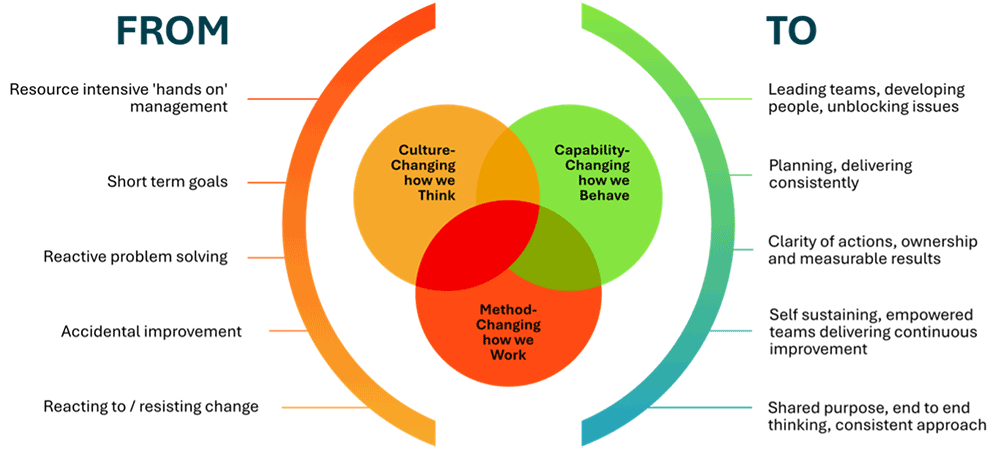
Continuous improvement involves employees working with customers and stakeholders, supported by managers, and with clear leadership and sponsorship from the Board and senior team.
People need to be provided with a method by which they can deliver continuous improvement for the benefit of themselves, the customers and your organisation; a win-win-win approach. Without a clear, simple method or framework within which people can make sense of where they are and where they need to get to, this type of culture change is very difficult to instigate and even harder to sustain. Intercloud9 recommends this is approached as an organisational transformation programme, as opposed to tackling people, efficiency improvement and technological change as separate strands or as short-term projects.
To meet and exceed the increasingly diverse needs and expectations of customers, your organisation must:
- Start with “outside in” thinking to truly see itself from the customer’s perspective and to respond appropriately.
- Develop strategies for engaging with customers, gathering knowledge about what matters to customers and use this knowledge to change the ways in which they think, behave and work.
As a result of this approach, customers are seen as intrinsic to your organisation, service improves continuously and capacity is generated, enabling your organisation to deliver more of what the customers wants with the same or less resource.
Most modern methods of managing people have not moved on greatly from those management practices developed during the industrial revolution. Our modern management practices encourage people to focus on personal targets and results, often at the expense of your organisation’s overall vision and purpose.
Intercloud9 recommends providing a framework for managers and employees to experiment together in a safe environment. Learning how to do things better is achieved through joint experimentation between managers and employees. Managers are free to focus less on managing people and more on methods for engaging people and improving and, ultimately, re-designing the services they are responsible for.
This new way of working provides employees with far greater satisfaction in their work since they can concentrate on developing more effective, efficient and stimulating ways to deliver services to their customers. They have information which shows the results of their experiments and how this has improved the service.
Managers understand that individual performance is little to do with individual motivation and much more do with how well “the system” supports the individual in being the best they can be. As managers are much more involved with the work employees do (in real terms, not just reading reports), observation of and feedback on performance is likely to be much more accurate and timelier. As the leadership style evolves from managing and controlling to facilitating and empowering, both employees and managers are more satisfied.
The reality is that any organisation that wants to deliver a new or refined vision and strategy requires some level of transformation to take place. The key obstacle to achieving organisational transformation is the culture of your organisation. Essentially, changing the culture of any organisation is extremely challenging and, Intercloud9 would suggest, is virtually impossible without a systematic approach.
The most successful organisations are those that move towards a culture where people feel empowered to continuously improve the products and services delivered by them, leading to optimising performance in a self-sustaining manner.
Intercloud9’s experience shows that without a clear process, methodology or framework, within which people feel “safe” to identify, plan, implement and measure change, any investment in technology will underperform and may result in severe disruption to both customer and end user.


